365days
Pickles
Oil, salt and sun. Made in one season, eaten all year.
Android build · pre-launch · Hyderabad first
CraveLink is a neighbourhood marketplace for homemade Indian food — pickles, podis, papads, namkeen, sweets. Every jar carries its net weight, its shelf life and its allergens. Every kitchen carries an FSSAI number. You collect it from the kitchen itself.
The shelf
These are the categories in the app, with the shelf life the app fills in for the maker before they ever touch the field. A maker can override it per jar — but nobody starts from a blank box and a guess.
365days
Oil, salt and sun. Made in one season, eaten all year.
180days
Dry-roasted and stone-ground. No water, so nothing spoils.
180days
Whole spices, roasted and milled to a house ratio.
180days
Rolled thin and sun-dried on the terrace, in batches.
270days
Fruit and sugar cooked down until it keeps itself.
30days
The long prep already done. Ten minutes on your stove.
21days
Namkeen fried in small lots, packed the day it is made.
15days
Mysore pak, laddu, burfi. Short window, worth it.
3days
The original category. Same-day, and deliberately kept.
Why it changed
This started as a home-bakery app. Cakes are same-day, perishable and local-only — a small business on a short clock. Pickles and podis keep for months, survive a journey, and are made in every second household in India. Same app, much bigger shelf. Bakes stayed on as one category so the kitchens already onboard were never orphaned.
Shelf life runs from 3 days for a bake to 365 days for a pickle.days a jar of pickle keeps
— against three for a cake
How it works
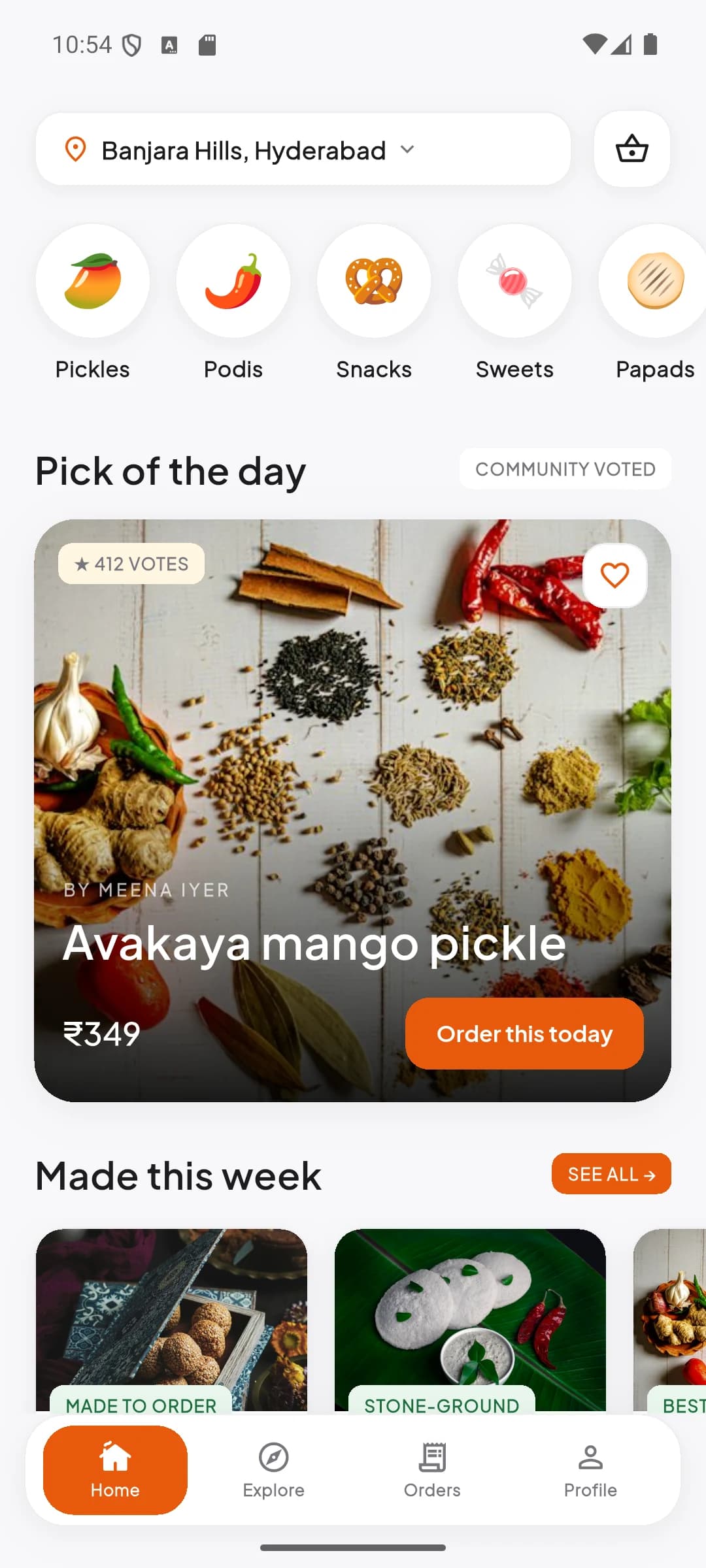
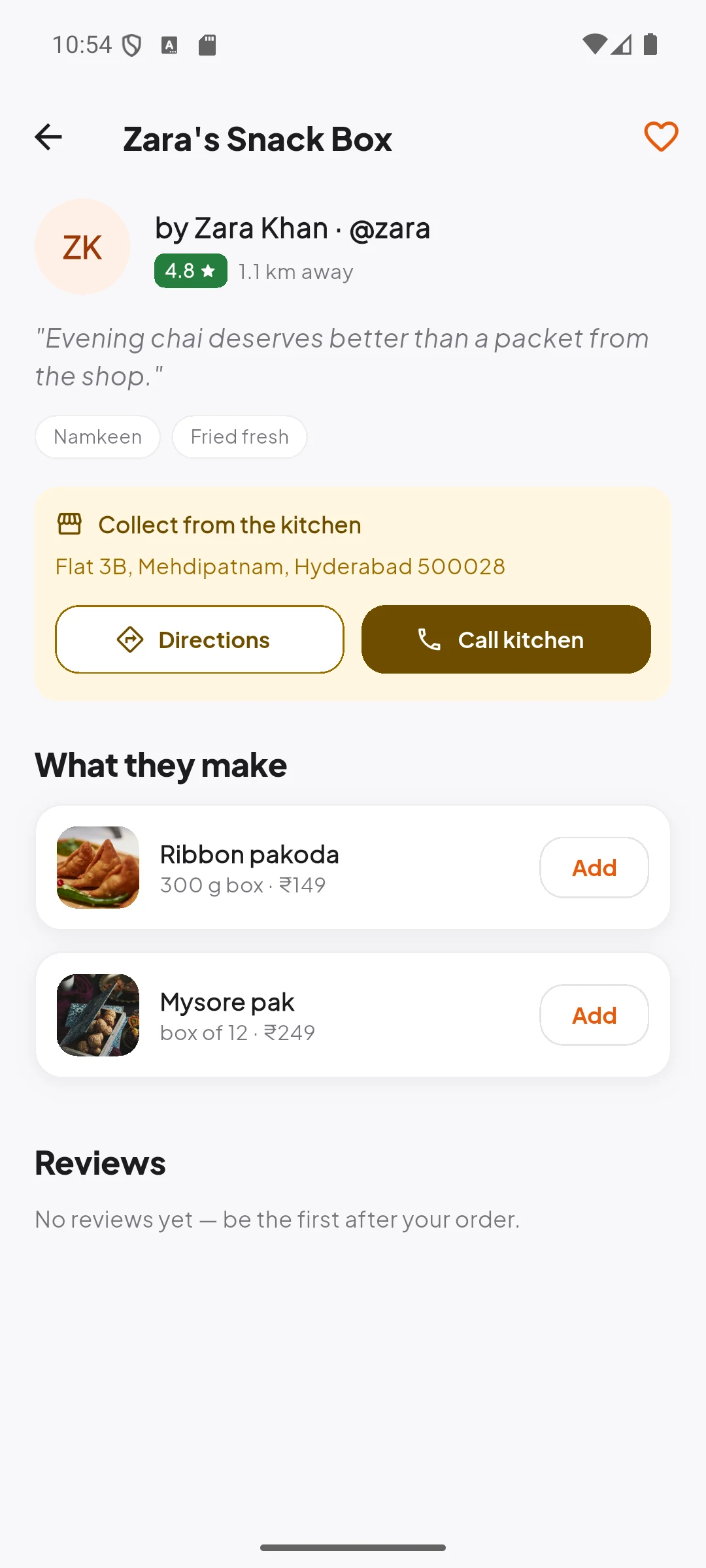
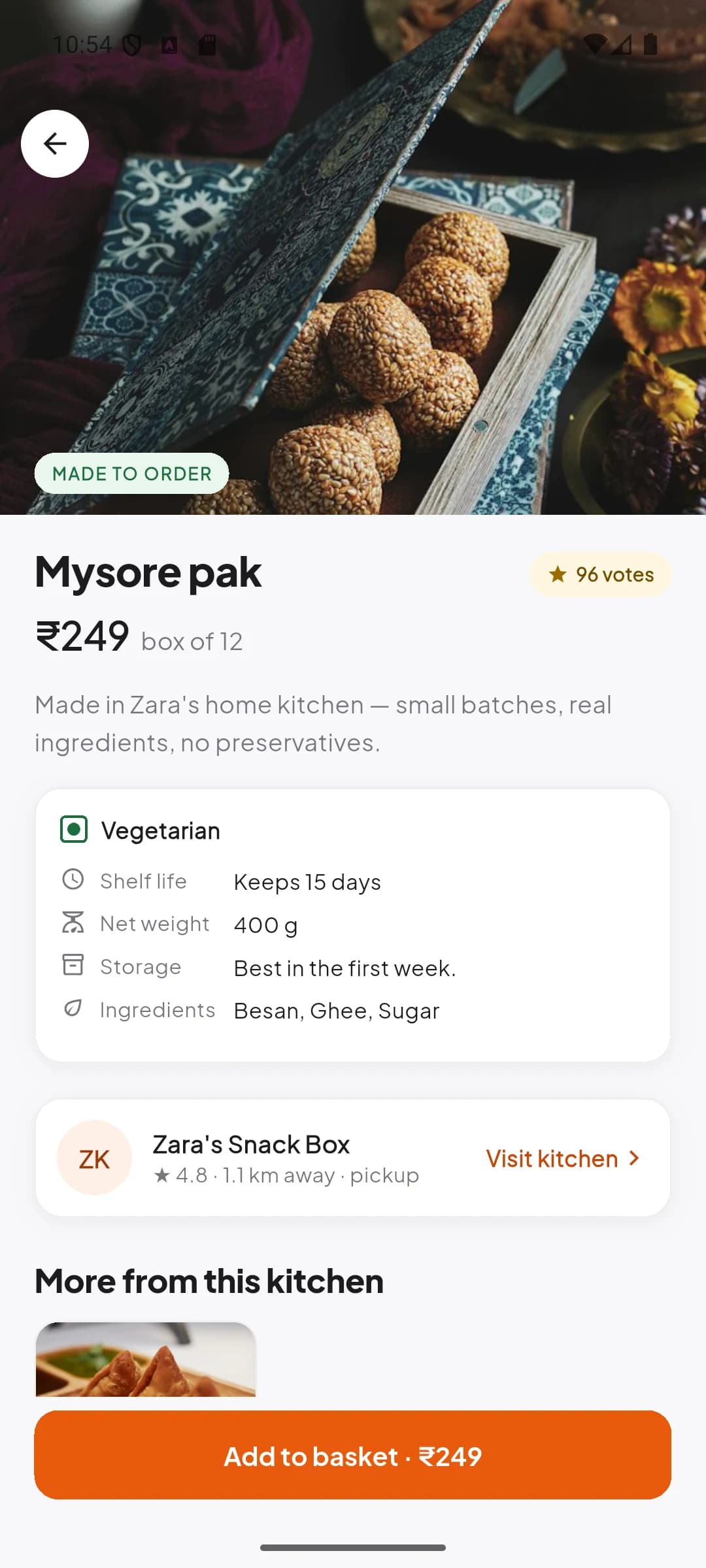
These are screenshots of the real Android build — not a mockup of one. The kitchens shown are the sample kitchens the app ships with for testing.
01 / Find
Set your area — type it, or use your location — and the feed re-sorts by real GPS distance. Pickles from 1.1 km away sit above pickles from six.
02 / Read
Every product carries net weight, shelf life, storage, veg mark, ingredients and allergens. Every kitchen carries an FSSAI registration number. Not a badge — the number.
03 / Pay
Razorpay checkout, signature-verified on our own server before an order is created. Then the status moves as the kitchen moves it, and your phone buzzes each time.
On the label
Selling packaged food in India needs at least an FSSAI Basic Registration, and the number has to appear on the pack. So the app asks the maker for the number, not for a tick box — and asks for net quantity, shelf life, storage, the veg mark, ingredients and allergens on every product before it can be published.
The form pre-fills the shelf life from the category so a first-time maker is not guessing, and they can override it jar by jar. Verifying those numbers against the FSSAI register, and moderating the photos, is the next piece of work — it is not done yet, and the page below says so.
The order, both ways
The kitchen moves the order along from their studio. Every move writes to the same document your phone is listening to, so your receipt changes while you are looking at it — and a push arrives either way.
Payment verified on our server before the order exists.
The kitchen takes it. Decline sends the money back.
Your jar is being filled. You watch it change, live.
“Ready — come and collect.” Address, directions, phone.
Receipt as a PDF, and the kitchen is yours to rate.
For home cooks
CraveLink was built for homemakers first — the people who have made the same avakaya every May for twenty years and have never had anywhere to sell it that was not a WhatsApp group.
Name it, write one line about yourself, drop a pin, add your FSSAI number. That is the whole of onboarding.
Per kg, box of twelve, per piece — your unit, your number. We never mark it up and never discount it for you.
Every order stores its own subtotal, our commission and your payout. The ledger is on the order, not in a statement you have to trust.
A push the moment it lands, an inbox with a “new” badge, and one button per state. No WhatsApp thread to lose.
Drag the order value. These are the three fields the server writes onto the order document itself, the moment it is created.
₹674
Settlement is a weekly manual transfer today — the ledger exists, the payout dashboard does not. That is on the list below, not in this paragraph.
What's actually built
Everything in the first column runs today against live Firebase. Everything in the other two does not. No landing page should need this section — this one does, because CraveLink has not launched and pretending otherwise would be the first broken promise.
Courier delivery via Borzo — built, tested end to end, and switched off behind a flag until their production access comes through. CraveLink is pickup-only until then, deliberately.
Questions
Not yet. The Android app is built and running on live Firebase — sign-in, catalogue, orders, payments, receipts and reviews all work — but it has not gone through Play Console review, so there is nothing to download. Hyderabad is the first city.
Courier delivery through Borzo is built and was verified end to end: live quotes at checkout, a real booking when the kitchen marks an order ready, webhook tracking, the lot. Their production access never arrived, and charging for a delivery no real rider will make is not something we will ship. So it sits behind a feature flag, and you collect from the kitchen.
Selling packaged food in India needs at least an FSSAI Basic Registration, and the number has to appear on the label. So we collect the number from the kitchen rather than showing a vague tick, and every product carries net weight, shelf life, storage, veg mark, ingredients and allergens. Verification of those numbers and photo moderation are the next things being built — they are not done yet.
Nothing to list. 10% of the item subtotal on an order that actually happens. Each order stores its own subtotal, commission and payout, and settlement is a weekly manual transfer — there is no payout dashboard yet, and pretending otherwise would be a lie.
To Razorpay. The order is created by a Cloud Function on our server, not by the app, and the payment signature is verified with HMAC-SHA256 before the order is trusted. Keys live in Google Secret Manager and never touch the repository.
It was — BakerNest, for home bakers. Cakes are same-day, perishable and local-only. Pickles and podis keep for months, travel well, and are made in every second household in India. Same app, much bigger shelf. Bakes stayed on as one category so the kitchens already onboard were not orphaned.
Hyderabad first
The app is not in the Play Store yet. If you cook and want to be one of the first kitchens on it when it lands, say so now — the first batch gets onboarded by hand.